
Do freelancers need an llc?
If you’re freelancing, you’ve probably wondered whether setting up an LLC (Limited Liability Company) is worth it — especially when tax season rolls around. Should you stay a sole proprietor or take the leap into forming a business entity?
The short answer: you don’t need an LLC to pay taxes as a freelancer, but there are strong reasons why you might want one.
In this guide, we’ll walk you through everything you need to know about LLCs, how they affect taxes, and whether it makes sense for your freelance business.
What Exactly Is an LLC?
An LLC (Limited Liability Company) is a business structure recognized by U.S. law that combines features of a sole proprietorship and a corporation.
It offers:
- Limited personal liability — protecting your personal assets if your business is sued or goes into debt.
- Flexible taxation — you can choose to be taxed as a sole proprietor, partnership, or S-Corp.
For freelancers, this means you can continue paying taxes similarly to before, but with added legal and credibility benefits.
Read more on Freelancers vs Self-Employed: What You Need to Know for Taxes & Deductions.
More information at U.S. Small Business Administration (SBA): What Is an LLC?.
How Freelancers Pay Taxes Without an LLC

When you freelance without an LLC, you’re automatically considered a sole proprietor by the IRS.
That means:
- You report income on Schedule C of your Form 1040.
- You pay self-employment tax (15.3%) for Social Security and Medicare.
- You make quarterly estimated tax payments.
Nothing changes in how you earn or report your income — the IRS doesn’t require you to register as a business to pay taxes.
For a step-by-step guide, see How to File Taxes If You’re a Freelancer for the First Time.
Source: IRS: Self-Employed Tax Center.
How Taxes Work When You Have an LLC
Here’s the key: forming an LLC doesn’t automatically change how you’re taxed.
There are three main tax options for LLC owners:
A. Single-Member LLC (Default)
If you’re the only owner, your LLC is taxed just like a sole proprietorship. You’ll:
- Report income on Schedule C.
- Pay self-employment tax.
- File your personal return as usual.
B. Multi-Member LLC
If you co-own the business, you’ll file a partnership return (Form 1065) and each partner reports their share on a K-1form.
C. S-Corporation (S-Corp) Election
You can choose to have your LLC taxed as an S-Corp to potentially save on self-employment taxes.
Instead of paying the full 15.3% on all profits, you can pay yourself a “reasonable salary” and take the rest as distributions — taxed at a lower rate.
Source: IRS: S-Corporation Election (Form 2553).
Read Should You Pay Yourself a Salary as a Freelancer? What You Need to Know (Pros & Cons).
Legal Benefits of an LLC for Freelancers

Here’s where an LLC truly shines — even beyond taxes.
✅ Limited Liability
Your personal assets (car, savings, home) are protected from business-related lawsuits or debts.
✅ Professional Credibility
Clients often see registered LLCs as more established and trustworthy businesses.
✅ Easier Business Banking
An LLC makes it simple to open a business checking account and manage income separately — which helps tremendously at tax time.
To stay organized with your expenses, see The Easiest Way to Track Tax-Deductible Expenses.
Financial Drawbacks of Having an LLC
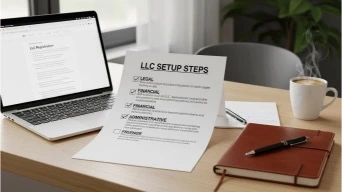
While LLCs offer benefits, they also come with added costs and responsibilities:
- State filing fees: Ranging from $50 to $500 depending on your state.
- Annual renewal fees or reports: Required in most states.
- Separate bookkeeping: You’ll need to manage accounts and paperwork more carefully.
When It Makes Sense to Form an LLC
An LLC is worth considering if:
- You earn $50,000+ per year consistently from freelancing.
- You want to protect personal assets.
- You’re working with large corporate clients that require business verification.
- You plan to grow into a small agency or hire subcontractors.
But if you’re just starting out or earning under $20,000, it’s often simpler (and cheaper) to stay a sole proprietor until your business grows.
How to Set Up an LLC Step-by-Step
Starting an LLC is easier than most freelancers think:
- Choose your business name (check your state’s registry).
- File Articles of Organization with your state.
- Pay the filing fee.
- Get an EIN (Employer Identification Number) from the IRS — free.
- Open a business bank account.
Source: IRS: Apply for an EIN Online.
Common Myths About LLCs for Freelancers
❌ Myth 1: You’ll Pay Less Tax Automatically
Forming an LLC doesn’t reduce taxes unless you elect S-Corp status and pay yourself strategically.
❌ Myth 2: You Need an LLC to Be Legitimate
Freelancers are legally self-employed — no LLC required to operate or pay taxes.
❌ Myth 3: LLCs Are Only for Big Businesses
Many freelancers form LLCs for personal protection even if they work solo.
Tax Tips for Freelancers with an LLC
- Keep business and personal expenses separate.
- Track income with tools like QuickBooks or Wave.
- Save 25–30% of each payment for taxes.
Source: IRS: Estimated Taxes Explained.
See How to Pay Estimated Taxes Without Stress.
Real Example: How an LLC Helped a Freelancer
Sara, a freelance designer, earned $90,000 last year. After forming an LLC and electing S-Corp status:
- She paid herself a $60,000 salary.
- Took $30,000 as dividends.
- Saved nearly $4,000 in self-employment taxes.
For her, forming an LLC made financial sense. But for smaller earners, the added costs might not be worth it yet.
FAQ
Q1: Do I need an LLC to pay freelance taxes?
No. You can pay taxes as a sole proprietor using your Social Security Number.
Q2: Is an LLC better for tax savings?
Only if you elect S-Corp status and pay yourself strategically.
Q3: How much does it cost to start an LLC?
Typically $50–$500 depending on your state.
Q4: What happens if I don’t form one?
You’ll continue filing as a sole proprietor — perfectly legal and acceptable.
Q5: Can I form an LLC later?
Yes! You can start as a sole proprietor and form an LLC anytime your business grows.
The bottom line

You don’t need an LLC for tax purposes — but it can make sense if you want legal protection, credibility, and potential long-term tax advantages.
If your freelance income is growing steadily and you’re working with bigger clients, forming an LLC may be a smart move.
But if you’re early in your journey, keep it simple, stay organized, and revisit the decision when your business matures. Whether you choose to stay solo or form an LLC, keep your finances organized with the tools and guides at FreelanceTaskAI.com — where smart freelancers work efficiently and confidently.
Our Authority Sources
- U.S. Small Business Administration (SBA): Choose a Business Structure
- IRS: Self-Employment Tax Center
- IRS: S-Corporation Election (Form 2553)
Simplify your freelance finances and make smarter tax decisions at FreelanceTaxcalc.com— where productivity meets profitability.